Folk Fest Prediction Tracker
It’s the end of August already, and one of my favourite summer events, the Edmonton Folk Music Festival, wrapped up two weeks ago.
I’ve been attending for the last ten years, lately with the same group of die-hard fans. It signifies the ending of summer, but it’s also something to look forward to, and there’s always a lot of anticipation waiting for the lineup to be announced.
This year, about one week before the announcement, my group chat got active making guesses about who was coming, or hoping for certain artists. We found ourselves searching and looking up those artists, hoping they might have a hole in their touring schedules. That’s when I found myself wondering if we could just get AI to do that for us and then build a database. It was surprisingly easy to do.
I opened up a Claude project and had it pull artists from the Winnipeg lineup to cross-check them against the Edmonton dates. Through a few iterations it was returning a lot of good information, and then I could just ask about other artists as we started thinking of them.
Which then brought me to my second issue: how to quickly share all of this information I was gathering back to the group chat. Someone would ask me to check a certain artist, I would run it through the project database, and then I would have to text back. But I wanted to share everything, and share it quickly, because this was happening in one conversation over one afternoon.
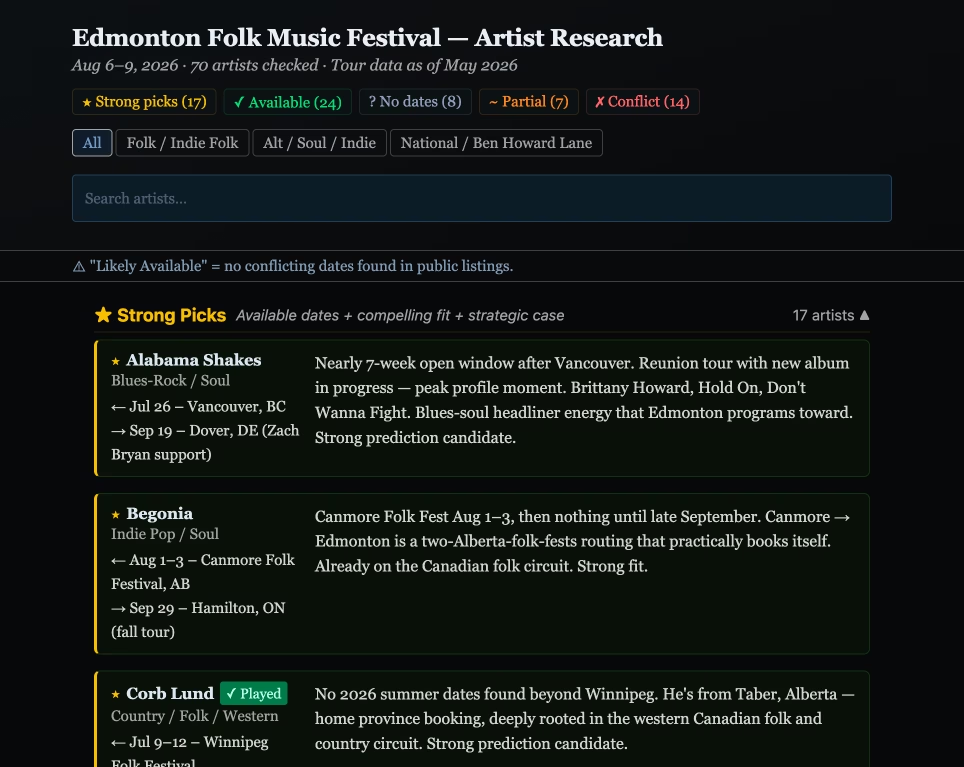
My next thought was that I needed to get this up online so I could share a link that everyone could follow. So I moved over to Claude Code and provided it with the database from the project, and boom, within the hour I had a website I could share and quickly update as we continued to look up more artists.
Here’s what I learned
I got to my end goal extremely fast, which was necessary to stay within the loop of the conversation as it was going. A day later and the momentum of the group chat might not have been there. It was actually impressive how quickly I was able to come up with an idea, build it, code it, and get it live.
Since I already set up the search for artists, we could keep iterating on it and adding new artist searches and clarifications. Then I was able to push that database and update the site with the click of a button.
The design of the app was done by Claude. The visuals worked, but it was lacking readability, since it created small font sizes and grey text over a black background. That was something important enough to me that I got into the code and edited it myself. I also restyled the search bar to make it more usable, but the functionality was there.
The database was initially created in the project as a .jsx file, so Claude Code built a React site with Babel to display it. That is not the way I would have approached it, and it’s probably overkill. But it worked, which again was the main goal.
If I were to do it again, which I hope to next year, I would have AI create a .json file that I could then incorporate into a simple vanilla JavaScript site. That way I could control the CSS externally and do more of my own styling. But I will say, taking AI’s default styles and then editing them also saved considerable time.
Surprise! AI makes mistakes. It took Of Monsters and Men out of the running because they were booked elsewhere on the opening day, which was only one day of the festival. But Of Monsters and Men did make it to Folk Fest the next day, August 7th. That might just be a context error, where I would have to be more specific about which dates to search for openings.
It also made errors with the code, and I did have to have it rerun and debug itself a few times. And in my last review of the code, there were some unnecessary lines left over from earlier iterations.
And knowing how to code myself is important. I had to know enough to know what to ask for, to tell it how to debug and what to look for, and then to override the inline CSS to create something that was at least readable, especially on a phone screen.
Would I do this again?
I plan to. Next year it will be interesting to see how I can improve it, both code-wise and for predictions. Plus it was fun, served a purpose, and it was built in one afternoon.